

The Hearing Triptych | Sound · Brain · Human Experience

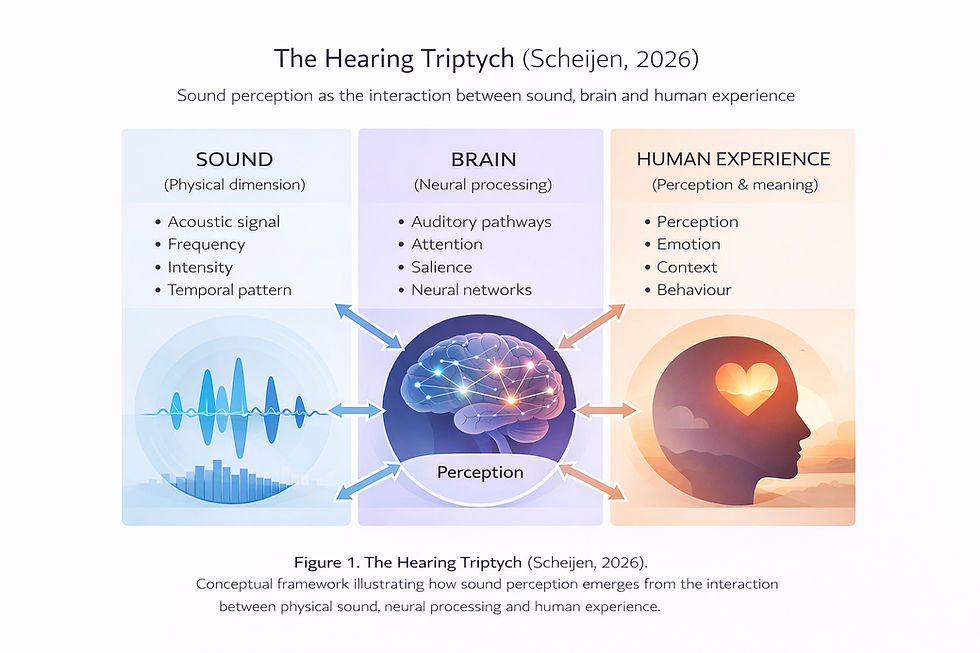
The Hearing Triptych
Sound · Brain · Human Experience
Background and resources for TRI 2026 Berlin
Welcome.
This page offers additional background to my presentation for TRI 2026 in Berlin on The Hearing Triptych: a clinical framework for understanding tinnitus not only as a sound, not only as a brain phenomenon, and not only as a psychological burden, but as the interaction between sound, brain and human experience.
Tinnitus care starts with listening.
Not only listening to the sound someone hears, but also to the meaning, fear, attention, avoidance, loss, resilience and life context that may surround it.
Why The Hearing Triptych?
In clinical practice, people with comparable audiological findings can experience tinnitus in completely different ways.
For one person, tinnitus may be present but manageable.
For another, it may dominate attention, sleep, work, relationships, silence and identity.
This difference cannot be explained by the auditory signal alone.
That is why tinnitus care needs an integrated perspective.
The Hearing Triptych brings together three essential dimensions:
1. Sound
The auditory dimension
This includes the measurable and audiological aspects of hearing:
hearing thresholds
auditory processing
sound exposure
hearing loss
tinnitus perception
loudness perception
hyperacusis
sound enrichment
masking
listening effort
The auditory signal matters.
But it is never the whole story.
2. Brain
The neurophysiological and attentional dimension
This includes the way the brain detects, filters, predicts and assigns meaning to sound.
Relevant processes include:
central auditory processing
attention
salience
prediction
autonomic arousal
emotional networks
threat detection
habituation
memory
stress physiology
The brain does not simply register sound.
It interprets, prioritizes and protects.
Sometimes, in tinnitus, the brain keeps listening to something that the person desperately wants to stop hearing.
3. Human Experience
The personal and existential dimension
This includes the lived experience of the person.
Tinnitus may touch:
fear
avoidance
loss
identity
sleep
work
relationships
silence
values
participation
grief
resilience
hope
meaning
This is where tinnitus becomes more than a symptom.
It becomes part of someone’s life story.
And that is exactly why clinical care must remain deeply human.
Not a replacement, but a connection
The Hearing Triptych is not meant to replace existing models.
It builds on important insights from audiology, neuroscience, cognitive behavioural therapy, acceptance and commitment therapy, rehabilitation medicine and everyday clinical practice.
Models such as the neurophysiological model of tinnitus, fear-avoidance models, CBT-based approaches and ACT all offer valuable perspectives.
But in the consultation room, these perspectives need to come together.
That is where The Hearing Triptych may help: as a visual and clinical way to connect scientific understanding with the lived experience of the person sitting in front of us.
From measurement to meaning
Audiological measurement is essential.
But tinnitus rehabilitation cannot stop at the audiogram.
In clinical practice, the central question often shifts from:
“What does the person hear?”
to:
“What does this sound mean in this person’s life?”
That shift is crucial.
Because suffering is not determined by sound alone.
It is shaped by attention, fear, control strategies, avoidance, personal history, loss, values and the possibility of living again.
From reducing tinnitus to expanding life
In tinnitus care, the question is often:
“How can we make the tinnitus smaller?”
That is an understandable question.
But in rehabilitation, another question may be just as important:
“How can we help life become larger again?”
When tinnitus is no longer the only thing that fills the glass, there may be more room for sleep, work, connection, creativity, silence, meaning and participation.
This does not deny the reality of tinnitus.
It places tinnitus within the broader reality of a human life.
The Glass Metaphor
One of the metaphors I often use in clinical practice is the glass.
When people suffer, their glass can become completely filled with tinnitus, fear, exhaustion, frustration and the constant struggle to regain control.
The goal is not always to empty the glass completely.
Sometimes, the most meaningful work is to make the glass larger.
To create more space around the tinnitus.
More space for values.
More space for movement.
More space for connection.
More space for life.
This perspective is strongly connected to Acceptance and Commitment Therapy.
Not as resignation.
But as a way of helping people move again toward what matters.
Where art meets science
My work as a clinical audiologist, ACT trainer and artist has deeply influenced the development of The Hearing Triptych.
In my clinical work, I meet people whose suffering cannot be captured by an audiogram alone.
In ACT, I work with the tension between pain and values, between control and openness, between struggle and committed action.
In art, I search for layers, contrast, light, silence and space.
The Hearing Triptych grew from that same place: the need to create a framework that is scientifically grounded, clinically useful and deeply human.
A framework that helps us move from signal to meaning.
From symptom to story.
From tinnitus to the human being who lives with it.
Further reading
You can read more about The Hearing Triptych, the artistic origin of the framework and the clinical metaphor behind my rehabilitation approach here:
The Hearing Triptych
Where Art Meets Science in The Hearing Triptych
The Glass Metaphor
More reflections on hearing, tinnitus and human experience
Contact
For questions, collaboration, lectures or clinical exchange:
Dyon Scheijen
Clinical Physicist Audiologist
ACT Trainer
Artist
Speaker
ART & ACT B.V. / Art of Hearing
Closing thought
Tinnitus is not only a sound.
It is sound, brain and human experience.
And perhaps the real challenge in tinnitus care is not only to understand the tinnitus better, but to help the person live again.


Comments