

Beyond the Sound

The Art of Hearing Triptych and the Glass Model in Sound-Related Distress
Introduction
“Does this mean my ear is not broken?”
It is a question I hear regularly in my consultation room. The question often arises after we have drawn a simple picture together: a glass slowly filling with everything a person carries in life.
Inside the glass I write words such as body, work, home and family - the domains that shape a person’s life. I sometimes add fatigue, stress or worry, the demands that gradually fill the glass. The word tinnitus I place next to the glass, because the sound itself is often not what fills it, but the drop that makes it overflow.
At that moment the sound suddenly becomes impossible to ignore.

Before reaching this moment of insight, however, many patients arrive with very different thoughts.
“I will never get rid of this.”
“This sound keeps me awake at night.”
“Something must be seriously wrong with my ear.”
These sentences reveal something important. The suffering is rarely caused by the sound alone. It is shaped by fear, attention, exhaustion and the meaning a person gives to what they hear.
When the glass becomes too full and begins to overflow, a sound may become the drop that makes everything visible.
For many people this realization brings relief. Not because the sound suddenly disappears, but because they begin to understand that their experience is not determined by the ear alone.
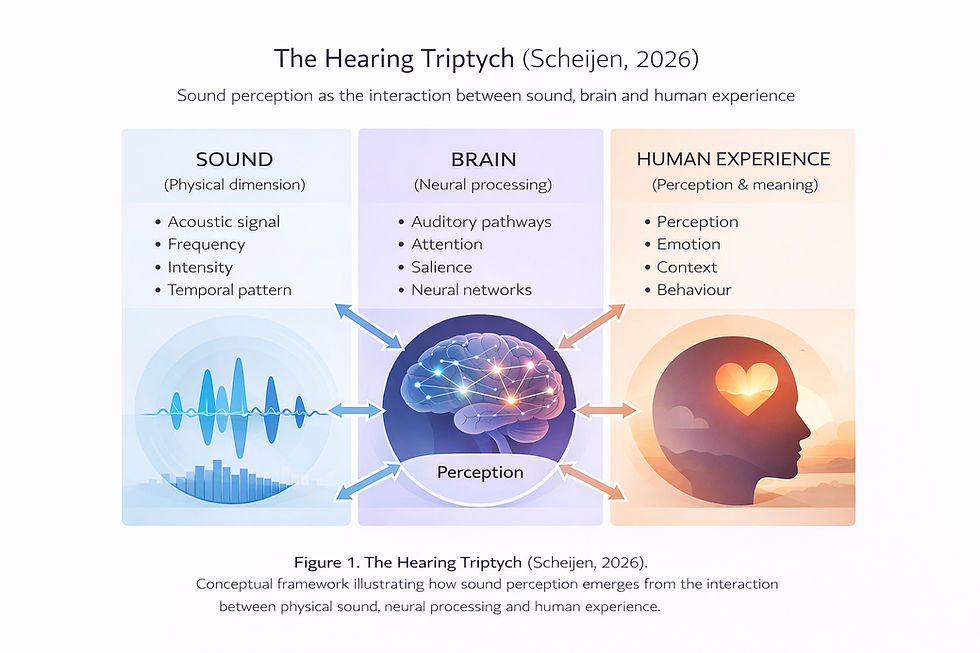
This observation forms the basis of a conceptual framework that has gradually taken shape in my work as a clinical physicist-audiologist. I refer to this framework as The Art of Hearing Triptych (Scheijen, 2026), describing the interaction between hearing, insight and life balance in sound-related distress.
Together these ideas help explain why sound sometimes becomes distressing - and why it may also lose its grip.
Sound-Related Distress
Sound is an essential part of human perception. Under normal circumstances the auditory system processes enormous amounts of information without us being aware of it.
Yet certain auditory experiences may become intrusive or distressing. This can occur in tinnitus, hyperacusis, or other forms of sound-related distress.
Tinnitus is commonly defined as the perception of sound in the absence of an external acoustic source. While this definition describes the phenomenon, it does not explain why many people experience tinnitus without distress while others find it deeply disruptive.
Epidemiological studies suggest that a large part of the population occasionally perceives tinnitus, whereas only a smaller percentage develops severe complaints.
Scientific models have tried to explain this difference. The neurophysiological model of tinnitus describes how auditory signals interact with emotional and autonomic systems, allowing a sound to acquire increased salience when interpreted as threatening.
Cognitive-behavioural research has further shown how attention, interpretation and avoidance behaviour can amplify distress.
From a clinical perspective, however, patients often benefit most from a simple framework that helps them understand their own experience.
The Art of Hearing Triptych
In my clinical work, sound-related distress can often be understood through the interaction of three domains.
Hearing
The first domain concerns the auditory system itself. Hearing loss, middle-ear pathology or other changes in the auditory pathway may influence sound perception. Careful audiological and medical assessment therefore remains an essential first step.
Insight
The second domain concerns understanding. When a sound is interpreted as dangerous or abnormal, attention naturally shifts toward it. Increased attention amplifies the perceived importance of the sound, which may in turn increase distress.
Providing insight into how perception and attention work often reduces fear and changes the way the sound is experienced.
Life Balance
The third domain concerns the broader context of life. Stress, fatigue, emotional strain and reduced resilience may all increase vulnerability to sound-related distress.
During periods in which life becomes overwhelming, sensory experiences that would otherwise remain neutral may move into the foreground of awareness.
Together these domains form The Art of Hearing Triptych (Scheijen, 2026): hearing, insight and life balance.
Importantly, sound-related distress rarely arises from a single cause. Rather, it reflects the interaction between these domains.
The Glass Model
In clinical conversations this interaction can be illustrated through a simple metaphor: a glass representing the balance between life demands and personal capacity.
Inside this glass we find the many aspects of life: health, work, relationships, responsibilities, worries and expectations about the future.
Importantly, the glass does not contain only problems.
It contains life itself.
The same things that give life meaning - caring for loved ones, commitment to work, concern for the future - may also fill the glass.
Within Acceptance and Commitment Therapy, difficult emotions are often understood as signals of what we care about. In that sense, a full glass often reflects a life that is deeply engaged with what matters.
However, when the cumulative demands exceed a person’s capacity, the glass may overflow.
At that moment even a relatively small stimulus - such as a sound - may become the final drop that reveals the imbalance.
From this perspective, the sound itself is not always the primary problem. It may simply expose a system that is already under strain.
Making the Glass Bigger
A common misconception is that the solution must be found in eliminating the sound.
In many cases this is neither realistic nor necessary.
Instead, a more helpful goal may be to increase the size of the glass.
Making the glass larger represents strengthening resilience, restoring energy and reconnecting with meaningful values in life. As the capacity of the glass grows, the same life circumstances can be carried without overflow.
In auditory science this process is often described as habituation: the gradual reduction of the perceived importance of a sound.
From a broader perspective, habituation can also be understood as the result of restoring balance within the whole system.
A Different Way of Looking at Tinnitus
One of the most powerful moments in clinical practice occurs when patients realize that their ear may not be “broken”.
Understanding sound-related distress as the interaction between hearing, insight and life balance often reduces fear and opens the possibility for change.
The process is rarely quick or easy. It requires patience, guidance and gradual steps.
Yet many patients discover that when the glass becomes larger, the sound that once dominated their attention slowly loses its central place in their lives.
Conclusion
Sound-related distress is rarely determined by the sound alone.
More often it reflects the interaction between auditory perception, interpretation and the balance of life.
The aim of care is therefore not necessarily to eliminate sound, but to enlarge the space of life in which sound can exist without dominating it.
This framework emerged from years of clinical conversations with patients experiencing tinnitus and other forms of sound-related distress.
Dyon Scheijen
Clinical Physicist-Audiologist
Art of Hearing
Where Art Meets Science


Comments