

The Hearing Triptych

Updated: Mar 25

The Hearing Triptych
Connecting Sound, Brain and Human Experience in Tinnitus and Sound Perception
Dyon Scheijen
Clinical Physicist Audiologist, Adelante Rehabilitation Centre, The Netherlands
Founder, Art of Hearing
Introduction
Within the field of hearing science, sound perception is often approached from distinct disciplinary perspectives. Acousticians focus on the physical properties of sound, such as frequency, intensity and temporal patterns. Neuroscientists investigate the neural mechanisms involved in auditory processing. Psychologists and clinicians explore the emotional, cognitive and behavioural responses that may arise when sounds become intrusive or distressing.
Each of these perspectives has contributed important insights. However, clinical practice consistently shows that sound perception rarely fits neatly within the boundaries of a single discipline. Patients with tinnitus or sound intolerance frequently describe experiences that cannot be fully explained by acoustics alone, nor by neural activity in isolation. Instead, sound perception appears to emerge from a dynamic interaction between physical stimuli, brain processing and the lived experience of the individual.
Over the past decades, several influential models have contributed to a broader understanding of this complexity. The neurophysiological model of tinnitus proposed by Jastreboff highlighted that tinnitus-related distress is not determined solely by the auditory signal itself, but by its interaction with the limbic and autonomic nervous systems (Jastreboff, 1990). In the United Kingdom, clinicians such as Hazell and Sheldrake translated these insights into clinical practice through tinnitus retraining therapy (TRT), emphasising the role of attention and emotional responses in shaping tinnitus perception (Hazell & Sheldrake, 1992; Jastreboff & Hazell, 2004).
Subsequent research has demonstrated that tinnitus involves distributed brain networks associated with attention, emotion and memory, rather than a single auditory generator (De Ridder et al., 2011). In parallel, cognitive behavioural approaches have shown how interpretation, attention and avoidance behaviour influence the extent to which tinnitus becomes distressing (Cima et al., 2014; Vlaeyen & Linton, 2000).
Taken together, these developments suggest that sound perception cannot be understood solely in terms of acoustic input or neural activity. Instead, it reflects the interaction between physical sound, brain processing and the broader human context in which sound is experienced.
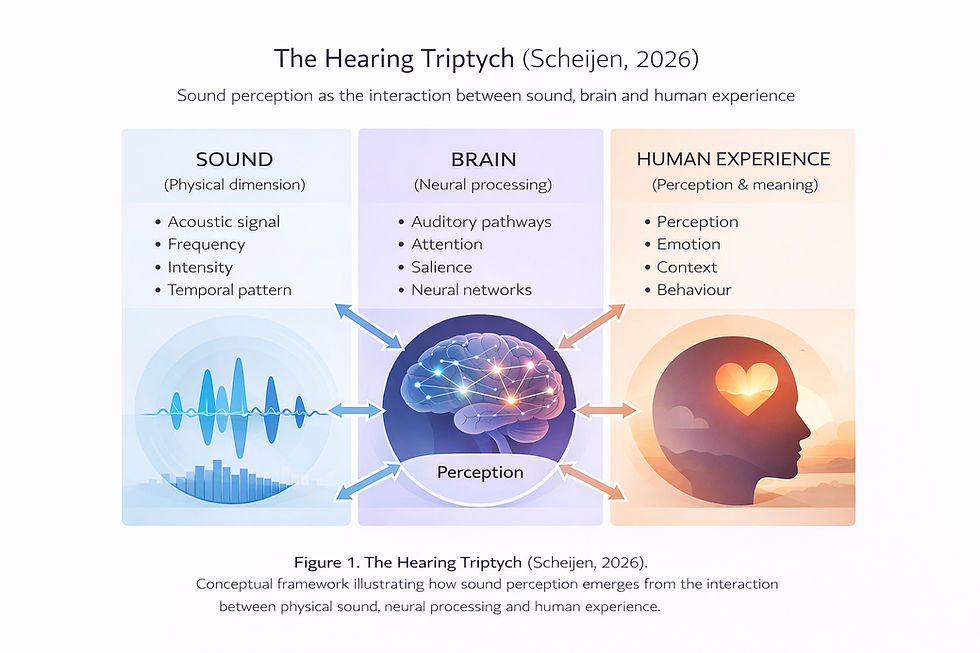
In this article, this interaction is conceptualised as the Hearing Triptych: Sound · Brain · Human Experience (Scheijen, 2026). Rather than proposing a new neurophysiological model, the Hearing Triptych is intended as a conceptual framework that highlights how sound perception emerges from the dynamic relationship between these three dimensions.
The physical dimension: sound
At its most fundamental level, hearing begins with physical sound. Acoustic signals can be described in terms of measurable properties such as frequency, intensity and temporal characteristics. These parameters form the basis of audiological measurement and acoustic analysis.
From this perspective, sound can be objectively quantified using physical and technical methods. However, while these measurements describe the acoustic properties of a signal, they do not explain why certain sounds are experienced as intrusive, meaningful or distressing.
Clinical observations show that individuals exposed to similar acoustic stimuli may report markedly different perceptual experiences. This indicates that sound perception cannot be reduced to physical characteristics alone.
The neural dimension: the brain
Between sound and experience lies the complex processing performed by the brain. Auditory signals are transmitted through the auditory pathways and processed across multiple neural networks. These extend beyond the classical auditory system and interact with broader brain systems involved in attention, salience detection and emotional regulation.
Research has increasingly highlighted the role of distributed brain networks in tinnitus perception (De Ridder et al., 2011). Attention mechanisms can amplify or attenuate the perceptual prominence of sound, while salience networks contribute to whether a signal is interpreted as relevant, neutral or threatening.
From this perspective, the brain does not passively register sound, but actively shapes how that sound is perceived.
The human dimension: experience
Beyond neural processing lies the domain of human experience. Sound perception takes place within a broader context that includes emotional responses, personal meaning, attention and behaviour.
Cognitive behavioural research has demonstrated that interpretation and attentional focus play a central role in how individuals respond to tinnitus (Cima et al., 2014). Fear-avoidance models further illustrate how behavioural and emotional responses can contribute to the persistence of distress (Vlaeyen & Linton, 2000).
In this sense, the experience of sound cannot be separated from the individual’s psychological and contextual environment. The same auditory signal may therefore be perceived as neutral, meaningful or distressing depending on the interaction between these factors.
The Hearing Triptych
When considered together, these perspectives suggest that sound perception emerges from the interaction between three interconnected domains:
• Sound – the physical acoustic signal
• Brain – neural processing and attentional networks
• Human experience – perception, emotion and behavioural context

The concept emphasises that sound perception arises not from a single system, but from the dynamic interaction between physical sound, brain processing and human experience.
Rather than replacing existing models, the Hearing Triptych aims to provide a conceptual bridge between disciplines that often approach sound perception from different perspectives.
Clinical implications
In clinical practice, patients with tinnitus or sound intolerance often encounter fragmented explanations depending on the discipline they consult. Some explanations focus primarily on acoustic or auditory mechanisms, while others emphasise psychological or behavioural aspects.
The Hearing Triptych suggests that these perspectives should not be viewed as competing explanations, but as complementary dimensions of the same phenomenon. Recognising how sound, brain processing and human experience interact may help clinicians communicate more effectively with patients and support more integrated approaches to tinnitus management.
Conclusion
Sound perception cannot be fully explained by acoustic properties alone, nor by neural activity in isolation. Instead, it emerges from the interaction between physical sound, brain processing and human experience.
Recognising this interaction may help bridge disciplinary boundaries within hearing science and contribute to a more integrated understanding of tinnitus and sound perception.
The Hearing Triptych aims to illustrate this relationship and to stimulate dialogue between fields that each offer valuable insights into how humans perceive sound.
References
Jastreboff PJ (1990). Phantom auditory perception (tinnitus). Neuroscience Research.
Hazell JWP & Sheldrake JB (1992). Hyperacusis and tinnitus retraining therapy. British Journal of Audiology.
Jastreboff PJ & Hazell JWP (2004). Tinnitus Retraining Therapy: Implementing the Neurophysiological Model. Cambridge University Press.
De Ridder D et al. (2011). Phantom percepts: tinnitus and pain as persisting aversive memory networks. Proceedings of the National Academy of Sciences.
Cima RFF et al. (2014). Cognitive behavioural treatments for tinnitus. Journal of the American Academy of Audiology.
Vlaeyen JWS & Linton SJ (2000). Fear-avoidance and its consequences in chronic pain. Pain.
Scheijen D (2026). The Hearing Triptych: Sound, Brain and Human Experience.
Art of Hearing (online publication).

Comments