

The Hearing Triptych | Sound, Brain and Human Experience - what Berlin brought together


Last week, I had the opportunity to attend TRI 2026 in Berlin. Presenting The Hearing Triptych . For me, that was more than a ten-minute presentation. It was special to be able to share a thought that has grown over many years in my clinical work with colleagues from all over the world.
Researchers, audiologists, ENT specialists, psychologists, and other professionals gathered in Berlin. I had known some for a long time. I met others for the first time. And I knew some names primarily from articles, books, and models that have shaped my own thinking.
That last point turned out to be important to me. Reading science is one thing. Meeting the people behind that science, listening to each other, and talking together suddenly makes that knowledge much more human.
Perhaps that is also exactly what The Hearing Triptych is about: connecting what is too often viewed separately.
A question that has occupied me for more than 25 years
I have been working as a clinical physicist-audiologist for over 25 years now, mostly with people with tinnitus and noise sensitivity. One question has continued to fascinate me all these years: how is it possible that two people with similar audiological findings experience their tinnitus completely differently?
One person hears tinnitus and goes on with their life. For another, that same perception affects sleep, work, relationships, concentration, safety, and ultimately almost their entire life.
If we only look at the sound, we do not understand that difference.
Sound is never just sound
As audiologists, we are accustomed to measuring: hearing loss, frequencies, decibels, speech intelligibility, and psychoacoustic properties. That remains essential.
But sound is never just sound. A sound can signify danger, contain information, evoke a memory, or connect us with another human being.
The ear receives the sound. But that is only the beginning of the story.
Existing models have helped me understand that story better. The work of Pawel Jastreboff showed how auditory perception can become connected to emotional and physiological responses. The fear-avoidance model , as applied to tinnitus by Rilana Cima and Johan Vlaeyen , among others , helped me understand what can happen when fear, attention, and avoidance become part of that process. Later, cognitive behavioral therapy and ACT were added. All those perspectives tell us something valuable. But the patient opposite me does not experience separate models.
He or she experiences one life .
Where models meet the patient
That is why, on my table during a consultation, there are sometimes literally different models lying side by side. Anatomy and audiology. Jastreboff. Fear avoidance. ACT. My drawings of the glass and life balance.

Not to give anyone a lecture, but to discover together: what can we measure? What does the brain do with it? What meaning has it acquired? Meanwhile, what happens at home, at work, within relationships, and with the things someone considers important?
This is where models meet the patient.
And perhaps The Hearing Triptych originated exactly there.
Then the artist joined in.
In addition to being a clinical physicist and audiologist, I am a visual artist and ACT trainer. While working on a triptych, I suddenly saw a parallel with my clinical work.
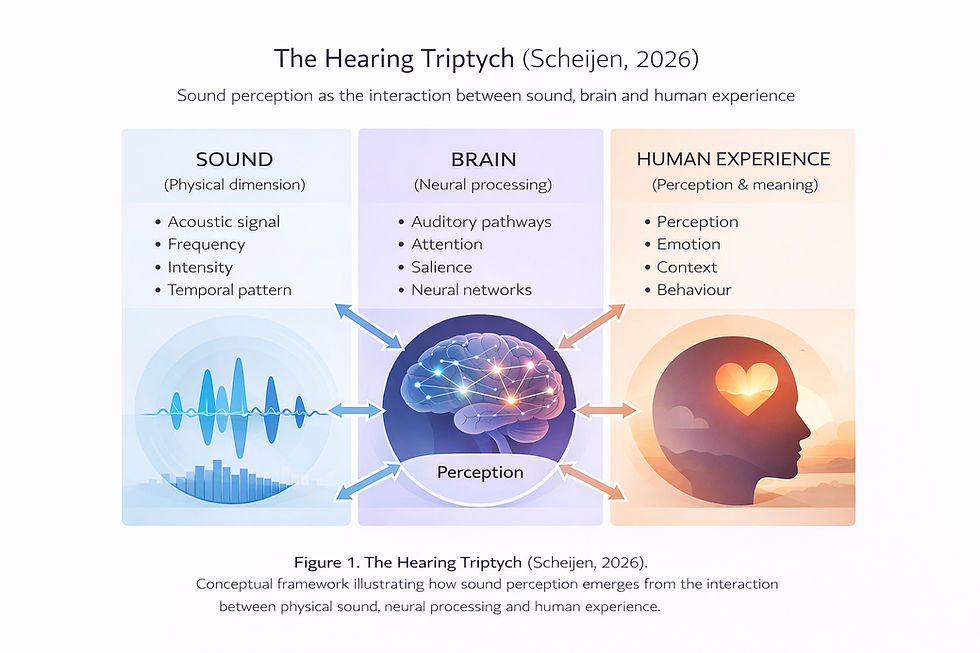
A triptych consists of three panels. You can view each panel individually. But only when you see them together does the complete work emerge.
For tinnitus, those were for me:
Sound. Brain. Human Experience.
Sound : what can we hear and measure?
Brain : what happens to that information — attention, meaning, emotion, expectation, and learning?
Human Experience : what does all this mean within the life of this unique person?
The three panels are not independent. They constantly influence each other.
Not a new model, but connection
During TRI, it became even clearer to me that this way of thinking is, of course, not new. George Engel's biopsychosocial body of thought has existed for nearly fifty years. Much of what we do within tinnitus fits perfectly within that framework.
The Hearing Triptych does not replace that. Nor does it replace Jastreboff, fear avoidance, CBT, or ACT.
The individual pieces are not new. The integration is the point.
For me, the Triptych is primarily a translation into audiological practice: from what we can measure, to what the brain does with it, to what a person actually experiences.
The people behind the science
Berlin added an extra dimension to this. It was special to speak with people whose work, from different perspectives, touches upon my own clinical thinking. Lance McCracken , from his work on chronic pain, ACT, and psychological flexibility. Carol MacDonald , from the connection between psychology and tinnitus care. Hashir Aazh , who has been demonstrating for years how psychological knowledge can be used within audiological practice.
And of course, there were many more. It was precisely the conversations between lectures, during dinner, or simply somewhere in a hallway, that impressed me. A name under a scientific article suddenly becomes a human being. You exchange experiences. You ask questions. Sometimes it turns out that someone from a completely different discipline is struggling with exactly the same question.
Science gives us knowledge. Meeting each other gives that knowledge another dimension.
Perhaps that is why we should not only connect models with each other. Perhaps we should above all connect people with each other .
From symptom reduction to life
For me, that is ultimately also the goal of rehabilitation. Of course, we must continue to investigate how tinnitus originates and how we can influence perception. But when the sound cannot be easily eliminated, our care must not stop.
Besides the question:
How can we reduce the tinnitus?
therefore another question may also be asked:
How can this person regain life?
Sleeping again. Working. Listening to music. Meeting people. Daring to do things. Not constantly controlling. Experiencing space again for what is truly valuable.
From symptom reduction to functional restoration.
How do we make the glass bigger?
That is why I ended my presentation in Berlin with Das Glas der Lebensakzeptanz , a metaphor that a colleague from a German tinnitus team gave me years ago.
We all know the question of whether the glass is half full or half empty.
But perhaps there is a more important question:
How can we make the glass bigger?

Throughout life, our glass fills with work, loss, relationships, illness, worries, memories, responsibilities, and sometimes tinnitus. We cannot get everything out of it.
But perhaps we can work on more space. More resilience. More psychological flexibility. More room for that which gives energy and meaning.
Not as a hidden method to make tinnitus disappear after all. But to prevent tinnitus from becoming a lifelong burden.
What I take away from Berlin
During TRI, I heard about psychoacoustics, brain networks, psychological factors, treatment, chronic pain, technology, and lived experience. Different disciplines looked at different parts of the same complex reality.
And because of that, my own thought actually became simpler and simpler:
Perhaps the pieces are already on the table.
Perhaps our next step is not just gathering even more knowledge. Perhaps we also need to become better at connecting what we already know.
Research with clinical practice. Audiology with psychology. Technology with human experience. And above all: people with people.
That is why it meant so much to me to be able to share The Hearing Triptych specifically during TRI 2026 in Berlin.
Not because I think I presented a new answer there.
But perhaps a different way of looking at the answers that already exist.
Sound. Brain. Human Experience.
Science explains mechanisms. Clinical practice reveals meaning. Rehabilitation connects both.
Because, after all:
Hearing is more than the ears.


Comments